

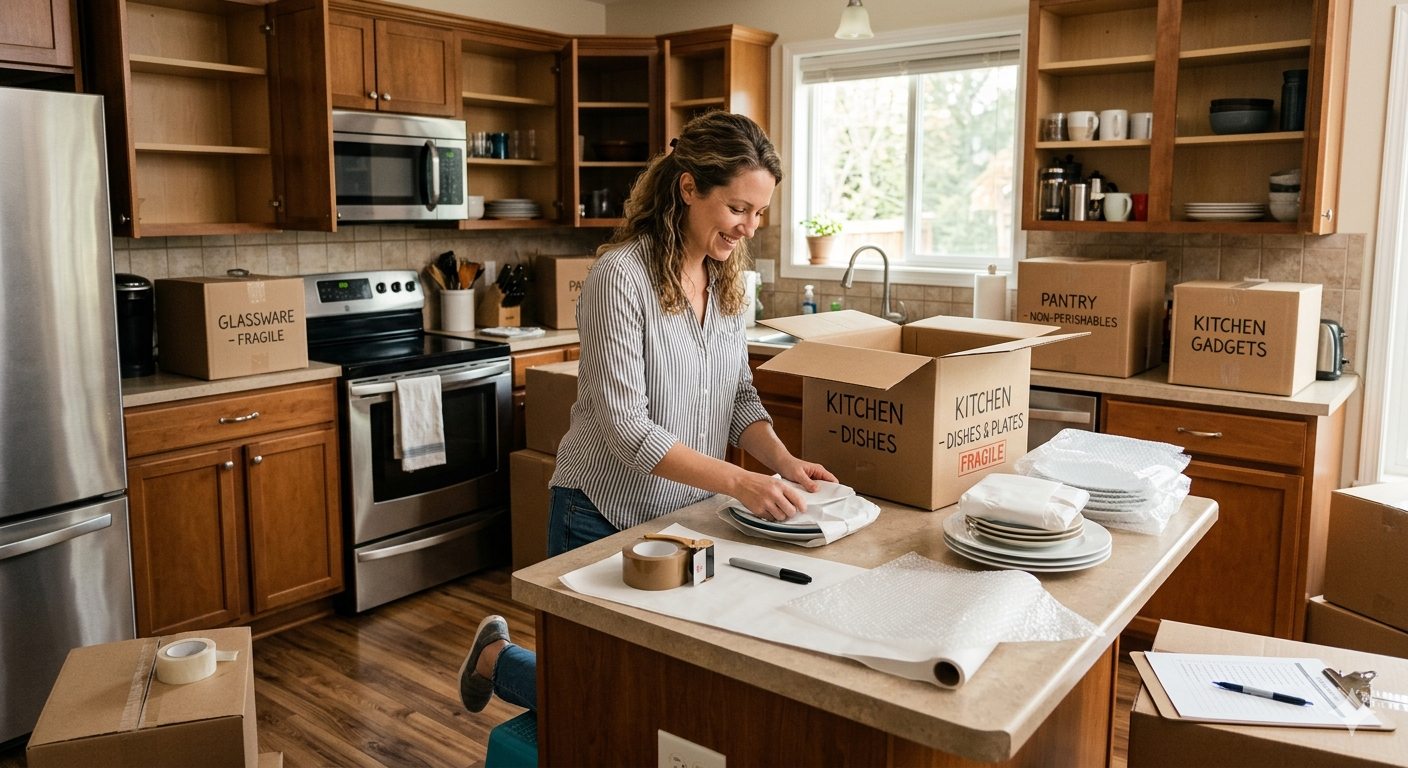
How to Pack a Kitchen for Moving: The Complete Room-by-Room Guide
The kitchen is the most time-consuming room to pack in any home. It has more individual items than any other space, more fragile pieces than any other space, and more categories of things that can’t be packed the same way. Most people seriously underestimate how long it takes — then find themselves still in the kitchen at 11 PM the night before the move.
This guide treats the kitchen as what it is: a project that deserves its own timeline, its own supply list, and its own strategy. Follow it and you’ll arrive at your new home with every glass intact and every knife exactly where you expect it to be.
How Long Does It Actually Take to Pack a Kitchen?
Before you touch a single box, set realistic expectations.
- Studio / bachelor (minimal dishes): 3–5 hours
- 1-bedroom apartment kitchen: 5–8 hours
- 2-bedroom apartment or small house: 8–12 hours
- Family home with full pantry: 12–18 hours
These estimates assume you’re packing alone, at a methodical pace, not rushing. Add 30–50% if you have a well-stocked pantry, a full set of china, or appliances you’re taking with you.
The mistake people make: starting the kitchen the night before the move. Start your kitchen four to seven days out — pack non-essentials first, leave a functional “everyday kit” accessible until the last morning.
For a structured approach to all rooms, our 8-week moving timeline for Ottawa shows exactly which week to tackle the kitchen as part of your full-home schedule.
Supplies You’ll Need Before You Start
Running out of packing paper mid-kitchen is a real problem — you’ll start improvising with towels and end up with dirty, damp boxes. Get everything in place before you open a single cupboard.
The Full Kitchen Packing Supply List
- Small boxes (1.5 cu ft) — qty: 10–15 — Dishes, canned goods, heavy items
- Medium boxes (3 cu ft) — qty: 8–12 — Pots, pans, small appliances
- Large boxes (4.5 cu ft) — qty: 3–5 — Pantry staples, lightweight bulky items
- Packing paper (newsprint) — qty: 2–3 reams (200+ sheets) — Wrapping every dish individually
- Bubble wrap — qty: 1 roll (at least 30m) — Glasses, stemware, fragile ceramics
- Packing tape (gun + rolls) — qty: 1 gun, 4–6 rolls — Don’t skimp — kitchens need a lot
- Permanent markers — qty: 2–3 — Label every box on two sides
- Zip-lock bags (assorted sizes) — qty: 1 box — Hardware, spice packets, small parts
- Shrink wrap / stretch film — qty: 1 roll — Wrapping knives, bundling utensils
- Cell dividers / dish pack inserts — qty: 2–3 sets — Glasses and stemware specifically
You can cut this cost significantly by sourcing free boxes. Liquor stores (especially LCBO) give away wine-glass-divided boxes that are perfect for stemware. Grocery stores give away banana and produce boxes that are dense and surprisingly strong. For a full list of free sources in Ottawa, see our guide to free packing materials in Ottawa.
Packing Strategy: What to Pack First
The kitchen has items you use daily and items you haven’t touched in months. Pack in reverse order of how recently you used something.
Week Before Moving: Pack These First
Start with items that won’t be missed during the final week of living in your old home:
- Specialty appliances you use occasionally: stand mixer, food processor, waffle iron, panini press, juicer, rice cooker
- Seasonal bakeware: holiday cookie cutters, specialty cake tins, muffin pans beyond the one you use
- Extra or formal dishware: the china set, the “good” glasses, the serving platters
- Duplicate items: if you have three spatulas, pack two; if you have four mugs you never reach for, pack them
- Pantry deep stock: canned goods, dried pasta, baking supplies you won’t use in the next week
- Books, recipes, and kitchen paperwork: manuals for appliances, recipe binders, grocery list pads
Two Days Before: Middle Layer
- Pots and pans (leave out one pot and one pan for the last two nights)
- Most baking supplies and tools
- Non-everyday cutlery and utensils
- Most dishes (leave out 2 plates, 2 bowls per person)
- Pantry middle layer: sauces, condiments, snacks not planned for the final two days
Moving Day Morning: The Last Kit
Leave these out until the very last box gets packed:
- The “moving day kit”: 2 mugs, 1 pot, 1 pan, basic cutlery, a knife, cutting board, dish soap, 1 sponge, 2 dish towels
- Coffee maker — non-negotiable for most households, packs last and unpacks first
- Snacks and easy food for moving day itself
- Trash bags: you’ll generate garbage while packing and cleaning
Pack the moving day kit in a clearly labelled box or tote bag that rides in your car — not on the truck. It’s the first thing you’ll want at the new address.
How to Pack Dishes and Plates
Dishes are the most common casualty of an unprofessional pack. The method matters more than the box.
The Individual Wrap Technique
Never stack plates flat in a box without wrapping each one. Every plate goes:
- Lay a sheet of packing paper flat on a table
- Place one plate at the corner, angled at 45 degrees
- Fold one corner of the paper over the plate
- Roll the plate forward, wrapping as you go
- Tuck in the remaining flaps
Wrap each plate individually. Two plates wrapped together is a false economy that creates a pressure point along the rim where chips happen.
How to Stack Plates in a Box
After wrapping individually, stand plates on their edge vertically in the box — never lay them flat. This is counterintuitive but correct. Plates are much stronger on their edges than their faces. Lay them flat and the weight of the boxes above cracks the face under pressure.
- Line the bottom of the box with at least 3 inches of crumpled paper
- Place plates vertically, tightly packed side by side
- Fill any gaps with crumpled paper — no movement means no breakage
- Add another 2–3 inch paper layer on top before closing
Label the box FRAGILE — PLATES — THIS SIDE UP.
How to Pack Glasses and Stemware
Glasses break because their rims and stems are structurally weak. The wrap method and the box type both matter here.
Wrapping Standard Glasses
- Lay the glass on a sheet of packing paper at the corner
- Tuck a ball of crumpled paper inside the glass before wrapping
- Roll the glass forward, rolling toward the opposite corner
- Twist the excess paper at the base to lock it
The paper inside the glass prevents the walls from caving inward under pressure — especially important for thin-walled tumblers.
Wrapping Stemware
Stems are the vulnerability. Wrap them with special attention:
- Wrap the bowl of the glass first with a sheet of paper
- Tear a separate strip of bubble wrap, wrap the stem and base, and secure with tape
- Do a final full wrap in packing paper
For wine glasses, champagne flutes, or any tall stemware: use cell dividers. A box with cardboard cell inserts gives each glass its own compartment. LCBO and SAQ (in Gatineau) use these for wine bottles and will give them away if you ask. Each glass sits isolated with no glass-to-glass contact.
Stand all glasses upright — never upside down or on their sides.
How to Pack Pots, Pans, and Cookware
Pots and pans are heavy and awkward but not particularly fragile. The main risks are scratching non-stick coatings and wasting box space.
Nesting and Padding
- Nest pots inside each other, largest to smallest
- Place a sheet of packing paper between each nested pot to prevent scratching
- For non-stick pans: place a paper plate, a folded piece of packing paper, or a dish towel between each pan — never stack bare non-stick surfaces
- Pack lids separately in a medium box, standing on edge like plates, wrapped individually
- Cast iron: pack separately in a small box (it’s very heavy). Line the bottom with paper. One to two pieces per box maximum.
Do not pack a pot in a box without something filling the interior — either nest a smaller pot inside it, or fill the cavity with crumpled paper, rolled kitchen towels, or dish cloths. Empty space inside a nested stack creates movement.
How to Pack Kitchen Appliances
The golden rule: if you have the original box, use it. The manufacturer’s packaging is engineered for exactly this purpose. For everything else:
Small Appliances (Toaster, Kettle, Blender, Coffee Grinder)
- Remove any detachable parts (trays, lids, blades, carafes)
- Pack parts in a zip-lock bag and place inside the appliance cavity or tape to the outside
- Wrap the appliance in packing paper, then add a layer of bubble wrap
- Pack in a box with paper on all sides — no movement
For blenders and food processors: remove the blade assembly before packing. Blades wrapped separately in cardboard (scored and folded around the blade) prevent injury during unpacking.
Coffee Maker
The coffee maker gets its own box or the moving-day kit treatment. If packing in a box:
- Empty the water reservoir completely (leave it open and upside down for 24 hours before packing)
- Remove the carafe and wrap separately in bubble wrap
- Wrap the machine body in packing paper, then place in a box with paper padding on all sides
Stand Mixer
A stand mixer is heavy (8–12 kg) and has an awkward centre of gravity. If you’ve kept the original box: use it. If not:
- Remove the bowl and all attachments
- Wrap the bowl and attachments individually in bubble wrap
- Wrap the body in a moving blanket and place in a large, reinforced box
- Pack the attachments in the bowl, then wrap the entire assembly together
- This box is heavy — label it HEAVY and keep it to one per stack
Large Appliances (Microwave, Toaster Oven)
- Wrap in moving blankets secured with shrink wrap or tape
- If the microwave goes on the truck: lay it flat with the door facing up, no items stacked on top
- Toaster ovens with glass doors: protect the door glass specifically with a bubble wrap layer
For major appliances — refrigerator, dishwasher, stove — see our guide to moving appliances safely, which covers disconnection, transit positioning, and reconnection step by step.
How to Pack Knives and Sharp Utensils
Knives are the most commonly mishandled kitchen items during a move — both for safety and for maintaining edge quality.
Individual Knife Wrapping
Never pack knives loose in a box. Each knife:
- Lay the knife at the edge of several layers of packing paper
- Roll forward, folding the paper over the blade with each rotation
- Tape the paper package closed
- Mark the outside of the package with “SHARP” in red marker
For a knife block: keep knives in the block. Wrap the entire block in packing paper, then shrink wrap. Pack upright in a box.
For a knife roll or case: wrap the closed roll in paper and pack flat in a box.
Other Sharps
- Scissors: close them, wrap in paper, tape the paper
- Cheese graters and zesters: wrap in paper with the sharp side facing inward; double-wrap if teeth are exposed
- Mandolines and peelers: remove any detachable blades, wrap separately; wrap the body in bubble wrap
How to Handle the Pantry
The pantry is where moving budgets and moving trucks gain unexpected weight. Approach it strategically.
What Not to Move
Moving perishables and heavy canned goods is almost never worth it. Do a pantry audit 2–3 weeks before moving:
- Perishables: use up fresh and refrigerated items before packing. Donate what you can’t finish.
- Canned goods: donate to a local food bank (Ottawa Food Bank accepts drop-offs). Moving 50 cans of beans costs more in labour than they’re worth.
- Open bags and boxes: finish them, or seal with a clip and move only if practical. Open containers in a moving box can leak and contaminate everything around them.
- Spices: many people move their spice collection out of habit. If your spices are more than 2 years old, this is your cue to start fresh. The weight isn’t worth it.
What to Pack and How
For pantry items you are moving:
- Seal open containers with tape or transfer contents to zip-lock bags
- Wrap bottles (olive oil, vinegar, sauces) individually in packing paper — lay them flat in a box padded with paper on all sides
- Tape lids on jars with a strip of packing tape around the rim
- Pack pantry boxes no heavier than 15 kg — canned goods get heavy fast. Mark these boxes HEAVY — PANTRY — THIS SIDE UP
Labelling Your Kitchen Boxes: A System That Works
Label every kitchen box with:
- Room: KITCHEN
- Contents category: DISHES / GLASSES / POTS / PANTRY / APPLIANCES
- Priority: UNPACK FIRST, UNPACK SECOND, UNPACK LAST
- Handling notes: FRAGILE, HEAVY, THIS SIDE UP
Write on at least two sides of each box. Boxes stacked in a truck or against a wall are frequently visible only from one side.
The “priority” system matters at the other end: when movers are unloading, they can stack low-priority boxes at the back of the kitchen and bring priority boxes forward. Your moving day coffee and cooking essentials go into a priority box — not buried under five boxes of serving platters.
For a complete list of all the supplies you need for every room in the house, our packing supplies checklist covers everything from tape guns to furniture blankets.
Packing the Refrigerator and Freezer
Start 48 hours before the move.
- Stop buying fresh food two weeks before the move; work down the fridge
- 48 hours out: defrost the freezer by unplugging and placing towels around the base
- Empty the refrigerator the morning of the move; clean it with a mild cleaner
- Dry completely; leave both doors open with a cloth inside to absorb residual moisture
- The refrigerator moves empty and upright — never on its side unless absolutely necessary, and if you must tilt it, allow it to stand upright for at least 24 hours before turning on at the new location
Pack any refrigerator contents you’re keeping in a sealed cooler with ice. This travels in the car, not on the truck.
What to Set Up First at the New Home
The kitchen is one of the first rooms to set up because you’ll need it on day one. At a minimum, unpack in this order:
- Coffee maker and kettle — plug in first
- Moving day kit box (the one you packed last): mugs, basic cutlery, one plate per person, dish soap
- Refrigerator: plug in and allow 2–4 hours to reach temperature before loading food
- Essentials drawer: one good knife, a can opener, a spatula, a wooden spoon
- Pots and pans you need for the first meal
Everything else can wait until day two. Don’t unpack every box on moving day — you’ll be exhausted and make poor decisions about where things go. Set up enough to function, then pause and reassess.
For a practical plan for the full 72-hour post-move period, our unpacking guide for the first 72 hours walks through every room in priority order.
Frequently Asked Questions
How many boxes does a kitchen take?
A 1-bedroom apartment kitchen typically fills 10–15 boxes. A full family home kitchen with pantry typically fills 20–35 boxes. The pantry adds the most volume; if you aggressively donate non-perishables first, that number drops significantly.
Can movers pack my kitchen for me?
Yes — most full-service moving companies include kitchen packing. A professional crew with the right materials and experience can pack a typical kitchen in 2–3 hours. If you’re considering full-service, get a quote that specifies kitchen packing as a line item. For guidance on what to include in a moving estimate, see our guide to getting an accurate moving quote.
Should I pack the kitchen or the movers?
If you’re trying to save money: pack it yourself with proper materials. If you’re short on time or have a large volume of fragile items: pay for professional packing for the kitchen specifically. The kitchen is the room most likely to generate damage claims when packed by non-professionals.
What do I do with liquid cleaning products under the sink?
Transfer only sealed, leak-proof containers. Double-bag everything in zip-lock bags before placing in a box. Partially used cleaning products — bleach, drain cleaner, oven cleaner — are not worth moving. Use them up or dispose of them responsibly. See our guide to hazardous items on moving day for disposal options in Ottawa.
How do I pack a stand mixer without the original box?
Detach all accessories and the bowl. Wrap each piece individually in bubble wrap secured with tape. Wrap the body of the mixer in a moving blanket. Place in a double-walled medium box with paper padding on all sides. The box should be heavy — if it feels light, add more paper. Label it HEAVY — FRAGILE — KITCHEN.


